


 Click it and Unblock the Notifications
I Got My First 3D Printer in 2026 and the Bambu Lab A2L Made Me Feel Stupid for Waiting

I have been "about to buy a 3D printer" since roughly 2023. You might know the type, if you are the type. I watched the videos, I knew what a hotend was in the way you know what a carburettor is, I could say "bed adhesion" in a sentence and sound convincing. What I actually knew was nothing. Every time I got close to buying, some forum thread about PID tuning or belt tension or manual bed levelling would show up and I would quietly close the tab and go back to reviewing phones, TVs or audio products. 3D printing looked like a hobby that demanded a second hobby just to get started.
The Bambu Lab A2L Combo is the machine that finally stuck me with reality. It costs Rs 65,999 with the AMS Lite unit that lets you print in four colours without needing to manually change the spool, or Rs 48,999 if you just want the printer. That is real money in a country where most people still think of 3D printing as something that happens in engineering colleges. So I did what I should have done years ago. I tried it, cleared my center table, and started printing things I actually wanted in my house instead of test cubes.

Weeks later I have a chess set on my coffee table, two wall posters that visitors keep touching to check if they are real, a hanging lamp, a wall rack, and a small army of action figures on my shelf. I have also wasted one spool in the dumbest way possible, which I will get to, because that failure taught me more than any of the successes.
| Specification | Detail |
| Price in India | Rs 48,999 printer only, Rs 65,999 Combo with AMS Lite |
| Type | Open frame Cartesian bed slinger |
| Build volume | 330 x 320 x 325 mm |
| Footprint and weight | 544 x 529 x 505 mm, 12.8 kg |
| Max speed | 500 mm per second, 20,000 mm per second squared acceleration |
| Extruder | Direct drive, hardened steel gear, built in filament cutter |
| Max nozzle temperature | 300 degrees Celsius |
| Nozzle sizes | 0.2, 0.4, 0.6 and 0.8 mm, tool free quick swap |
| Max bed temperature | 80 degrees Celsius |
| Build plate | Textured PEI flexible steel plate |
| Calibration | Full auto bed levelling, flow dynamics calibration, adaptive vibration compensation |
| Multi colour | AMS Lite, four spools, expandable |
| Filaments | PLA, PETG, TPU, PVA supports, not suited to ABS or ASA |
| Monitoring | Camera with AI failure detection, nozzle clump detector, runout and tangle detection |
| Connectivity | Wi Fi, LAN only mode, Bambu Handy app, microSD, 3.5 inch touchscreen |
| Noise | Under 49 dB silent mode, around 52 dB standard |
| Power | Up to 1000 W peak at 220 V |
| Warranty in India | 12 months via authorised channel partners |
Bambu Lab A2L AMS Lite Review: Two-Minute Review
I had been putting off buying a 3D printer for years because the hobby always seemed to come with a long list of things to learn first-bed levelling, belt tension, temperature tuning and plenty more. The Bambu Lab A2L Combo changed that experience almost immediately.
Setup is genuinely simple. From unboxing to the first print, the machine can be ready in around 30 to 45 minutes. Auto bed levelling, vibration compensation and calibration take care of much of the technical work that traditionally made 3D printing intimidating.
The A2L also has a large 330 x 320 x 325mm build volume, giving you enough space to print everything from helmets to large decorative objects. Print quality is where it really impressed me. Detailed chess pieces, layered wall art, lamps, wall racks and articulated figures all came out cleaner than expected, with very little post-processing required.
Then there is the AMS Lite. It supports four filament spools and allows automatic colour changes, making multi-colour prints look far more polished. However, every colour swap creates waste filament and can significantly increase printing time. The open AMS Lite also means filament moisture can become a concern in humid environments.
The printer isn't completely foolproof. It needs a heavy, stable table because vibration can be substantial at higher speeds. And while its AI-based failure detection can catch some problems, basic print preparation still matters. Keep the build plate clean and, most importantly, don't move it while a paused print is still attached.
At Rs. 65,999 for the Combo, the Bambu Lab A2L isn't cheap. But between its easy setup, excellent print quality, large build volume and AMS Lite colour printing, it makes 3D printing feel far less like a technical project and more like a creative tool.
Bambu Lab A2L AMS Lite Review: Ease of Setup
Setting it up was the part I was a little dicey about. But, I can assure anyone with no experience can simply follow the instructions and get it set up and running in 30-45 minutes at max. You take the A2L out of the box, remove a few screws and foam blocks, click the gantry into place, plug it in, connect it to Wi-Fi, and the machine starts calibrating itself. It measures the bed using the nozzle, works out its own Z height, checks for vibration and compensation, and then asks if you would like to print something. I kept waiting for the hard part but the hard part never arrived.
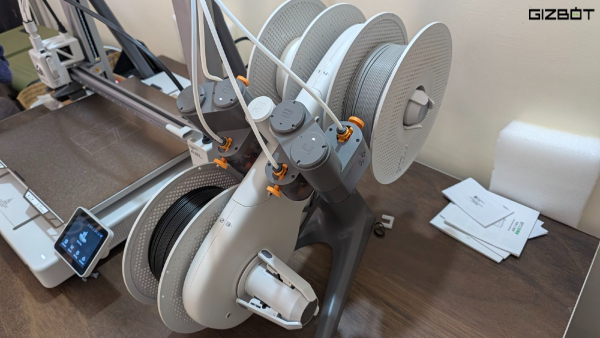
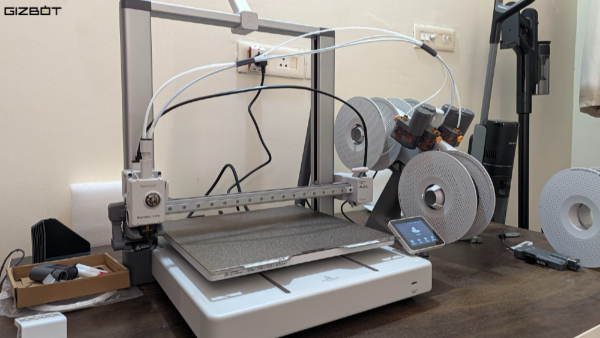
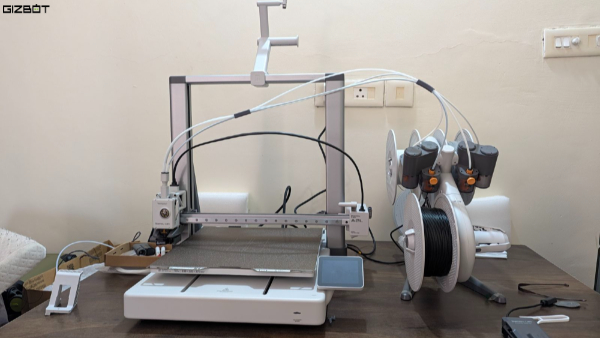
I am not exaggerating when I say the longest step was deciding where to keep it. The A2L is big. The printer itself takes up roughly 54 by 53 centimetres of floor space on your table and stands about half a metre tall, and once you attach the AMS Lite on top with four spools loaded, it starts looking less like an appliance and more like a small industrial installation in your living room. The build volume is 330 by 320 by 325 mm, which in practical terms means you can print a full sized helmet in one piece or fill the entire plate with twenty small pieces and let it run overnight. Coming from the assumption that beginner printers give you a tiny 200 mm square to play with, this feels quite generous.
One real warning -this machine shakes. It is a bed slinger, which means the plate itself throws back and forth under the nozzle at speeds up to 500 mm per second, and at full pace the whole table moves with it. My first instinct was to put it on a light folding table and that lasted exactly one print before I moved it to a solid wooden table against a wall. If your table wobbles when you type on it, the A2L will find that out and make it your problem. It doesn't just need a sturdy table - it needs a sturdy, heavy and extremely stable surface so that your print quality doesn't suffer. I had to put two foam blocks at one side of the table and bump it to the wall to make it stable.
Bambu Lab A2L AMS Lite Review: Performance
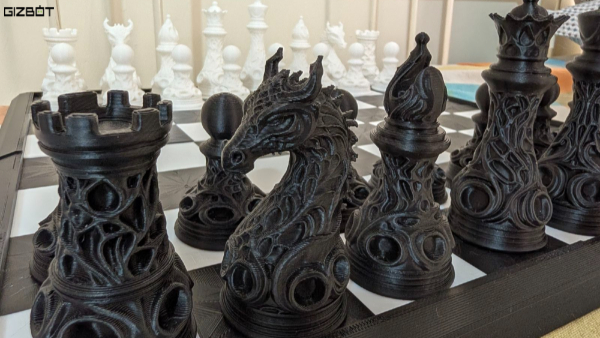
I started with a chess set because it is the classic ego test. Thirty two pieces, lots of small curved detail, and a board that has to be flat or the whole thing looks cheap. The pawns and rooks, despite being an intricate design, came out clean enough that I did not sand anything. The knights, which are the piece that exposes every weakness in a printer, came out with the mane detail intact and only the faintest layer lines you have to hold up to a lamp to see. My friends assumed I had bought it.
Then I got ambitious and printed two wall posters. The first is that photograph of The Beatles walking together in Russell Square in London from July 1963, all four of them, Lennon, Starr, McCartney and Harrison, mid stride. The second is the Mac Miller Circles cover. These are not simple prints. They are layered colour prints where the machine builds the image in thin bands of different coloured filament so that light and shadow come from the material itself rather than from ink. The Beatles poster took most of a day. When I peeled it off the plate and held it up, I sat down. There is a moment in this hobby where the object stops being a print and starts being a thing you own, and for me it was that one.
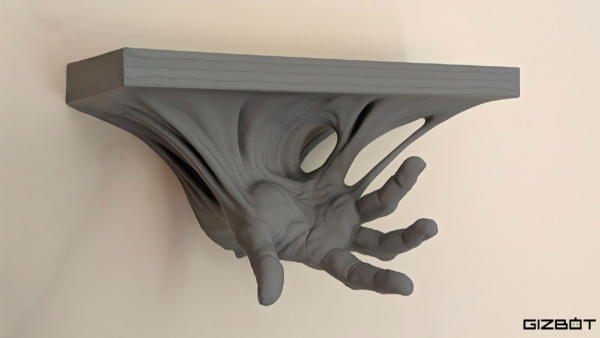
After that it was a hanging lamp, which throws lovely patterned shadows on the ceiling and cost me maybe a hundred rupees of filament, a wall rack for my desk clutter, and a steady stream of articulated action figures that print in one piece and come off the plate already able to move. My nephew has taken three of them and has stopped asking me for toys from the market, which I am counting as a financial win.
Across all of it the quality was consistently better than I expected at this price. Bambu quotes 500 mm per second and 20,000 mm per second squared acceleration, and while you will not use those numbers for anything you care about, even the slower quality profiles finish faster than the printers I had been reading about in 2022. The stock textured PEI plate gives a nice pebbled finish on the bottom layer and releases parts once it cools with a slight flex and a pop.
Bambu Lab A2L AMS Lite Review: Build Quality
The AMS Lite is what turns this from a printer into a colour printer. Four spools sit on motorised holders on top of the machine, each with its own tube feeding into the extruder, and when your model needs a different colour the printer retracts one, snips it, and feeds another. Bambu's own filament carries RFID tags so it recognises what you loaded automatically. For anything with more than one colour, and that includes both my posters, the chess set and most of the action figures, it is what makes the result look bought rather than made.
Now the honest part. Every colour change means the printer has to purge the old colour out of the nozzle, and that purged material goes into a little tower of waste next to your model. On a print with a lot of swaps, that tower can end up weighing a surprising fraction of what the actual model weighs. You can reduce it by telling the slicer to flush waste into the model's internal infill and by grouping similar colours together, but you cannot make it go away. The other cost is time. A model that takes under three hours in one colour can easily take six or seven in three colours, because the machine spends a large part of its life changing filament rather than printing.
The AMS Lite is also completely open to the air, which matters more in India than it does in the marketing videos. Filament absorbs moisture, and moist filament pops and hisses at the nozzle and gives you weak, stringy prints. If you live in Mumbai, Chennai or Kolkata, budget for a dry box or a filament dryer from day one and treat it as part of the purchase rather than an accessory.
One more thing worth knowing. Flexible TPU filament does not play well with the AMS Lite because it buckles inside the feed tubes. For anything flexible, load it on the single spool holder and feed it directly.
Bambu Lab A2L AMS Lite Review: Design and Comfort
My first real failure was the one every beginner gets. I came back to the machine and found it cheerfully extruding plastic into thin air, weaving a bird's nest of what the community calls spaghetti. The model had lifted off the plate early in the print and the nozzle had spent the next hour drawing in mid air.
What I learned is that spaghetti is not a printer problem, it is an adhesion problem. The first layer either sticks properly or it does not, and the reasons it does not are boring and fixable. There was oil from my fingers on the plate, because I had been picking the plate up by its surface instead of the edges. Now I clean the plate with dish soap and warm water every few prints, wipe it with isopropyl alcohol before anything important, and add a brim to models with a small footprint so they have more surface gripping the bed. I have not had a lift since.
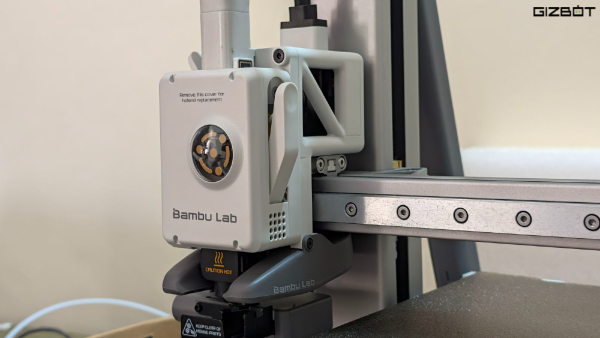
To its credit the A2L does try to save you. It has a physical detector that catches material clumping on the nozzle, it monitors the extruder for irregular flow, and it runs camera based AI failure detection that pauses the print and pings you on the Bambu Handy app with a photo. It caught two failures for me before they turned into a full hour of waste. It is not infallible, and if you set the sensitivity high it will occasionally panic over nothing, but the fact that it exists at all on a printer at this price still feels slightly unfair to everyone who bought a machine in 2019.
Bambu Lab A2L AMS Lite Review: Comfort and Fit
This is the expensive lesson and the one I most want you to take from this review, because I had not read it anywhere before I did it.
I was printing the rack, which was my biggest single print. Somewhere in the middle of it my spool ran out. The printer did exactly what it should, paused, and told me to load new filament. While I was fiddling with the spool I shifted the build plate slightly with my hand. Not lifted it, not removed it. Just nudged it a centimetre or so to get better access, the way you would move a plate on a dining table.
The printer resumed, and it had no idea the plate had moved. Everything it printed after that point was offset from everything it had printed before, so the rack had a clean bottom half, a visible seam where my mistake was recorded forever, and a top half floating a centimetre to the left. There is no recovery from this. The machine has no way to know the geometry under it has shifted, and by the time you notice, you have burned hours and a lot of filament on something you have to throw away.
So here is the rule I now follow like religion. While a print is paused, you may change the spool, you may clear the nozzle, you may stand there and admire your work. You may not touch, lean on, lift or adjust the build plate. If the plate has to come off, the print is over. Learn this from my dead rack rather than from your own.
Bambu Lab A2L AMS Lite Review: Features and App Experience
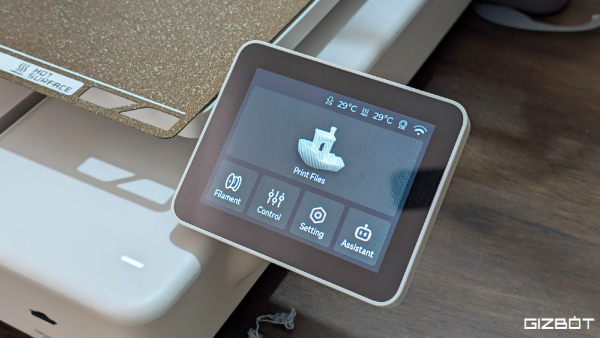
Bambu Studio is the slicer, which is the software that turns a 3D model into instructions for the printer, and it is the reason I got useful results in week one. It comes with profiles for every filament and plate combination the machine supports, so the entire universe of temperature and speed settings that used to be the hobby is now a dropdown. You pick the material, you pick quality, you hit slice.
MakerWorld is Bambu's model library and it is where almost everything I printed came from. Millions of free models, filtered by which printer you own, most of them already set up with the right colour assignments for the AMS. There is also a free tool called Chroma Canvas inside it that converts a photograph into one of those layered colour posters, which is how both my wall pieces started life. You upload an image, it works out the layers, you print it.
The app side is solid too. Bambu Handy gives you a live camera feed, progress, and the ability to pause or stop from your phone, which matters more than it sounds when a print is running overnight and you wake up at 3 am wondering.
The caveat is philosophical but real. Bambu runs a fairly closed ecosystem. In January 2025 the company pushed a firmware update that routed third party slicer control through its own authorisation layer, and a large part of the maker community took it badly, arguing it locks users into Bambu's cloud and software. There is a LAN only mode if you do not want your printer talking to a server, and for a normal user who is going to live inside Bambu Studio and MakerWorld anyway, none of this will affect your Sunday. If you are the kind of person who wants to flash custom firmware, run a print farm on your own software, or simply dislike being tied to one company's cloud, factor it in before you spend the money.
Bambu Lab A2L AMS Lite Review: Features
The A2L is quiet. Bambu rates it under 49 dB in silent mode and around 52 dB normally, which in practice is a hum you stop noticing. It ran overnight in the same room I slept in and I slept fine. PLA and PETG, the two materials most people will actually use, are low odour and the machine carries indoor air quality certification with Bambu's own filaments, so it is fine in a bedroom or a home office with normal ventilation.
Power draw peaks at up to 1000 W but that is mostly in the first few minutes while the bed heats, after which it settles into something closer to a ceiling fan. Electricity is not the cost here, filament is. A 1 kg spool of Bambu PLA Basic runs roughly Rs 1,299 to Rs 1,499 in India and third party options from eSun or WOL3D cost less, and a spool goes a long way if you are printing decorative objects rather than solid bricks. My chess set, lamp, rack and figures together have not eaten one full and 80% of two spools.
What the A2L will not do is print ABS or ASA properly, because it is open framed and the bed maxes out at 80 degrees. Those materials need an enclosure to stop them warping. If you specifically want tough automotive grade parts, you are looking at an enclosed printer instead. For everything a normal person prints at home, PLA, PETG and the occasional bit of TPU cover it.
On service, Bambu entered India formally this year and sells through authorised partners rather than its own service network, with a 12 month warranty on the printer and the AMS Lite. Buy locally. Importing one yourself from the US or Europe means customs, higher landed cost, and a machine that nobody in India is obliged to fix, because Bambu does not support international service.
Bambu Lab A2L AMS Lite Review: Value for Money
Here is what nobody tells you when you are on the outside looking in. Once you own a machine this good, printing stops being the interesting question within a month. You will run out of things on MakerWorld that you actually want in your house, and then you will look at a gap on your desk, or a bracket that broke, or an idea in your head, and realise that the only thing standing between you and that object is knowing how to model it.
That is the real skill, and it is the one the A2L cannot do for you. I started with Tinkercad, which is free, runs in a browser and is genuinely aimed at people who have never opened a CAD program. My first attempts were embarrassing. Boxes with holes in the wrong place. A phone stand at an angle that made the phone slide off. But the loop between drawing something and holding it an hour later is unlike any learning loop I have had in years, because the feedback is physical. You see exactly what you got wrong, you fix one dimension, you print it again.
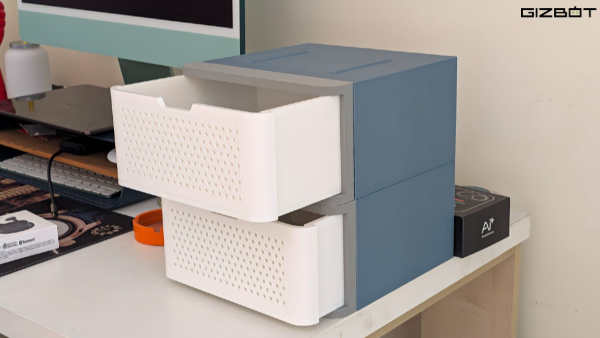
I am four or five iterations into a desk organiser I designed myself and it is the object in my house I am most annoyingly proud of, more than anything else, because the machine only executed it. And the more competent I get at modelling, the more the printer stops being a gadget and starts being a tool, which is a transition I did not expect to enjoy this much.
Bambu Lab A2L AMS Lite Review: Verdict
Buy it if you are the person I was, circling this hobby for years, convinced you need to be an engineer to start. You do not. The A2L removes almost every technical barrier that used to define 3D printing, gives you a build plate large enough that you will rarely have to cut a model into pieces, and the AMS Lite turns your output from grey plastic prototypes into things you are happy to hang on a wall. At Rs 65,999 for the Combo it is not cheap, but it is the difference between a printer you use and a printer that becomes a guilt object in a cupboard.
Skip it, or at least think harder, if your table is flimsy and you have nowhere solid to put it, if you specifically need ABS grade parts and therefore need an enclosure, if you are on a tighter budget where a Creality or Elegoo machine will get you 80 percent of the way for meaningfully less, or if a closed cloud ecosystem is something you object to on principle. Those are all legitimate reasons. None of them applied to me.
| Attributes | Notes | Rating |
|---|---|---|
| Ease of Setup | Setup is so easy it feels like a trick | 4.25/5 |
| Performance | The prints that made me a believer | 4.75/5 |
| Build Quality | AMS Lite is the best part and also the most expensive part | 4/5 |
| Design and Comfort | Spaghetti happens, and it is almost always your fault | 4.4/5 |
| Comfort and Fit | Never nudge the build plate, and I mean never | 4/5 |
| Features and App Experience | Software, MakerWorld and the small print about the ecosystem | 4.5/5 |
| Features | Living with it in India | 4.25/5 |
| Value for Money | The printer is the easy part, the drawing is the real hobby | 4.5/5 |
-
 54,999
 -
 99,999
 -
 1,44,900
 -
 89,998
 -
 46,500
 -
 57,998
 -
 53,989
 -
 1,59,999
 -
 1,29,999
 -
 99,999
-
 70,499
 -
 1,56,900
 -
 1,30,990
 -
 17,084
 -
 16,999
 -
 30,999
 -
 9,999
9,999 -
 79,900
 -
 8,999
8,999 -
 79,999
-
 20,999
 -
 37,999
 -
 25,999
 -
 31,999
 -
 24,999
 -
 10,999
 -
 15,999
 -
 45,999
 -
 19,499
 -
 1,61,999
-1763362932432.svg)

 Continue with Google

