


 Click it and Unblock the Notifications
Qualcomm Introduces Snapdragon Game Super Resolution Feature for Mobile Game Performance and Battery Life

Qualcomm has introduced a new Snapdragon Game Super Resolution (GSR) feature for maximizing mobile game performance and battery life.
The GSR feature is a "single pass spatial aware super-resolution technique" developed by Qualcomm for scaling the quality of images, keeping performance and power efficiency intact.

GSR is said to be the fastest among all resolution upscaling techniques currently available. While many are based on bilinear interpolation (bilerp) their graphic quality tends to be compromised, whereas others that increase graphic quality require inputs that are not common in mobile rendering pipelines.
How does Snapdragon Game Super Resolution work?
The Snapdragon GSR feature is a single pass spatial upscaling technique optimized for Snapdragon Adreno GPUs. It uses range-aware dynamic scaling with customizations for the Adreno GPU pipeline.
Qualcomm claims it has twice the performance improvements compared to other mobile upscaling solutions. It also offers visual quality and graphics closer to the native game render.
The Snapdragon GSR feature can currently be used to improve gaming performance and battery life on devices with a Snapdragon chipset and also on partner GPUs. The company added that while the feature is compatible with several GPUs, it gives the best performance when used on Snapdragon chipsets.

Some of the features offered by the GSR are as follows:
1. It increases the resolution keeping the visual quality of graphics intact.
2. It also increases the frame rate and battery life, besides increasing visual fidelity while maintaining framerate.
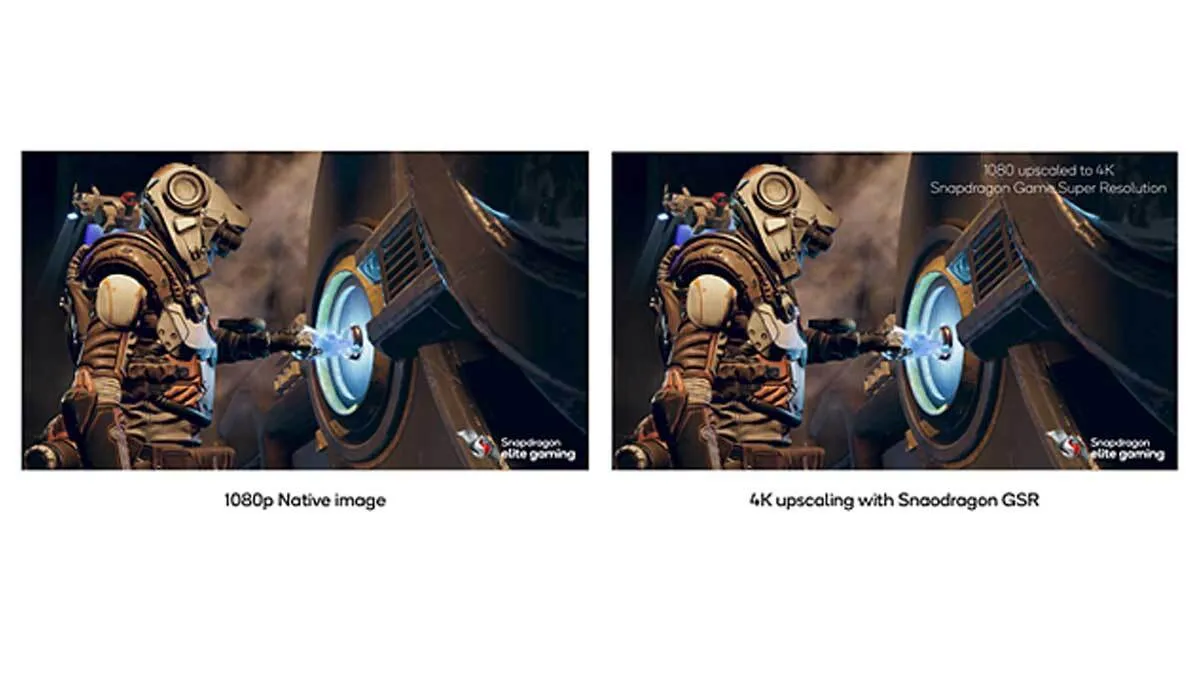
Qualcomm claims that the Snapdragon GSR feature allows users to play 1080p games in 4K resolution and 30FPS games in 60+ FPS resolution without compromising battery life.
How is the Snapdragon GSR so fast?
The GSR feature achieves its speed by using as few registers, texture samples, and Arithmetic Logic Instruction (ALU) instructions as possible on Adreno GPUs. While other techniques use at least two passes over the input image, GSR uses only one pass, which reduces power consumption and increases speed.
Apart from that, GSR also uses fewer ALU instructions and texture samples than other techniques. It also uses a 12-kernel window where the luminance calculation is performed using the green (G) channel as the human eye is most receptive to this color.
Now, since it uses only one component for each pixel calculation with a three-component interpolation, Adreno GPUs offer 100 percent shade processor utilization.
-
 1,29,999
 -
 22,999
 -
 64,999
 -
 99,999
 -
 29,999
 -
 39,999
 -
-
 63,999
 -
 1,56,900
 -
 96,949

-
 1,39,900
 -
 1,29,900
 -
 79,900
 -
 65,900
 -
 12,999
 -
96,949
-
 16,499
 -
 38,999
 -
 30,700
 -
 49,999
-
 19,999
 -
 17,970
 -
 21,999
 -
 13,474
 -
 18,999
 -
 22,999
 -
 19,999
 -
 17,999
 -
 26,999
 -
 5,999
5,999
-1763362932432.svg)

 Continue with Google

