


 Click it and Unblock the Notifications
I Spent Some Time With the Samsung Galaxy S26 Series, Here’s What You Need to Know

The Samsung Galaxy S26 series has been in the headlines for months now, and while everything was leaked and re-shared multiple times, I was still interested in seeing what it would be like in real life. Now, if you have the Galaxy S24 or S25 series, there’s very little for you to be upgrading. And that’s not shocking at all at this point; that’s how tech has been in the past few years. But there are still some quality-of-life improvements here that had me interested.
And that starts with the Privacy Display feature, which is exclusive to the Samsung Galaxy S26 Ultra. Besides that, the vanilla S26 and S26 Plus also get some minor adjustments, and a different chip for the Indian variant. I spent about an hour with all three S26 devices, and here’s what’s new and what’s pretty much the same.

The Privacy Display is a game-changer
This is the headline feature of the Galaxy S26 Ultra. Samsung worked on the hardware level to make this happen, and they’re calling it the Flex Magic Panel. It essentially uses two different types of pixels: Narrow and Wide, which play with angles and how light is dispersed.
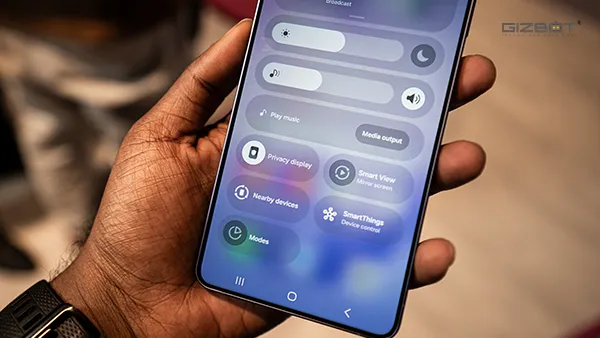
When the Privacy Display is turned on, the Narrow pixels focus light toward the person using the phone, while the Wide pixels limit the light spread. This makes it almost impossible for someone standing to the side to see what’s happening on your screen.
You can toggle the feature from the quick settings panel, but since this is built into the hardware rather than being a physical layer, Samsung added a bunch of conditions for when it kicks in. For example, you can set it to enable automatically when you open apps like WhatsApp, PayTM, or Google Pay. Similarly, you can have it trigger whenever you’re typing in a PIN or password to unlock your phone.
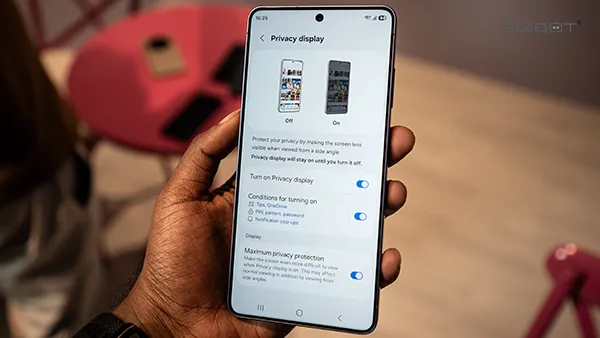
But there’s one specific implementation I liked the most: the privacy layer can be applied to just the notification pop-ups instead of the entire screen. It’ll automatically blur or shield the layer whenever a WhatsApp message bubble or a bank transaction appears. It’s a very cool touch and shows the kind of control you get when things are handled at a hardware level. This is something you simply wouldn’t get by just sticking a privacy screen guard from the market onto your phone.
What else is new on the Galaxy S26 Ultra
In essence, the Galaxy S26 Ultra is just a series of refinements over the S25 Ultra (Review). Interestingly, just as Apple moved away from Titanium, Samsung has done the same, switching back to Armor Aluminum. This has helped the S26 Ultra shave off a few grams, but more importantly, the phone is now slimmer at 7.9mm. Combined, this is a major departure from the bulky and sharp S24 Ultra and a more ergonomic refinement over the S25 Ultra. Beyond that, the camera module now has a unified look similar to the Galaxy Z Fold7. The colour options remain largely mundane, though a new Sky Blue shade adds some much-needed freshness.
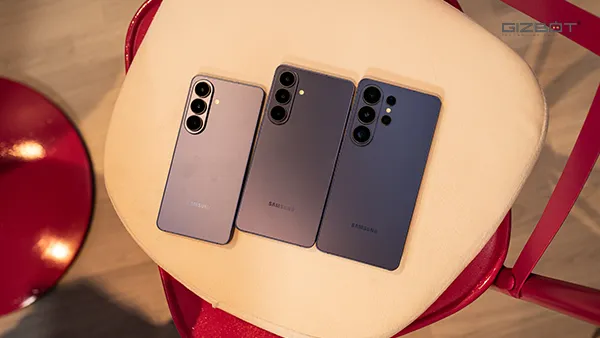
Under the hood, the S26 Ultra runs the Qualcomm Snapdragon 8 Elite Gen 5 (tuned for Galaxy) with up to 1TB of storage and 16GB of RAM. The cameras remain largely the same, even as brands like OPPO, Vivo, and Xiaomi make massive strides in this department. Samsung is sticking to the exact same setup: a 200MP primary, a 10MP telephoto (3x), a 50MP periscope (5x), and a 50MP ultrawide. The only real difference is that the primary and periscope cameras now have lower aperture values, offering a bit more flexibility in low light. The selfie camera is still a mere 12MP shooter.
On the video front, the phone can record up to 8K 30fps and now supports the Advanced Professional Video (APV) codec for pro-level creators. Samsung also detailed a 4K auto-framing feature that maintains the details of the video while keeping the subject centred, which can be useful for busy environments like concerts. There’s also a Horizontal Lock feature that keeps the frame level even if the phone is tilted or rotated.
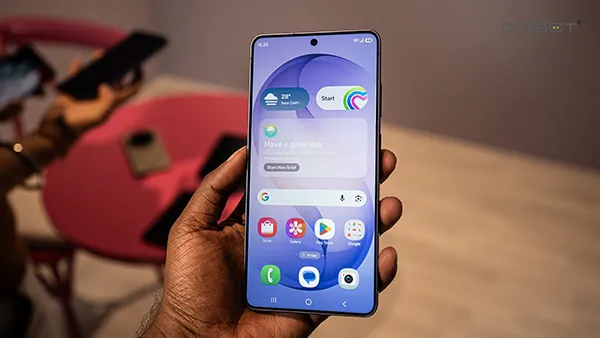
Samsung is branding this as an "AI phone," which naturally means there are plenty of new features. While I couldn't test them all in my short time with the device, the Photo Assist in the Gallery now supports written prompts if you don't want to draw on the image. There’s also a new Now Nudge feature, which feels like Magic Cue from the Pixel 10 series. For example, it can prevent you from double-booking a meeting by reading a message from a friend and "nudging" you about an existing schedule. It can also suggest photos from your gallery if a friend asks for pictures from a shared trip. Currently, this works in Messages and Gallery. Additionally, Audio Eraser now supports third-party apps like Instagram and YouTube to help clean up background noise.
The Galaxy S26 Ultra still uses the same 5,000mAh battery we’ve seen for the last five years, so there’s no change here. However, they’ve finally made a move on the charging speeds. The Ultra now supports up to 60W wired and 25W wireless charging.
Galaxy S26 and S26 Plus are Bystanders
The Galaxy S26 and S26 Plus get the same general treatment in terms of display and form factor. The S26 remains the compact choice with a 6.3-inch display, while the Plus retains the 6.7-inch screen. Unfortunately, the Privacy Display feature is exclusive to the Ultra, so you won’t see it here. It’s likely a feature that will trickle down to the vanilla phones next year.
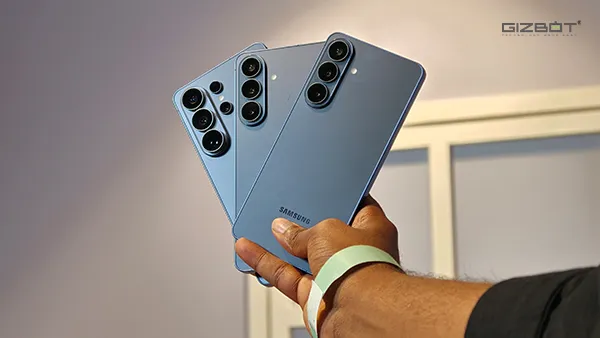
Outside of India, both phones get the Qualcomm treatment, but here in India, they feature the first-ever 2nm-based Exynos 2600. We’ll be getting the units soon for a deeper dive into their performance, so make sure you stay tuned to Gizbot.
There are virtually no hardware upgrades on the camera front for either phone, so you can expect pretty much the same performance as last year. However, the base S26 does get a slight boost in the battery department, moving up from 4,000mAh to 4,300mAh. That said, if you are already rocking a Galaxy S24 or Galaxy S25, there is really nothing here that will force you to upgrade your phone this year.
Final Thoughts
The Galaxy S26 series is a bit of a mixed bag this year. On the one hand, the S26 Ultra’s Privacy Display is a genuine innovation that solves a real-world problem, and also shows the kind of hardware innovation that Samsung is capable of. Moreover, the move to a 10-bit panel makes it the best display on a smartphone. Even the base S26 feels like it’s finally getting some love with that battery bump to 4,300mAh. But all of this comes with a catch: the price.
With the S26 starting at ₹87,999 and the Ultra pushing even further into the premium bracket, these aren't easy recommendations anymore. The S26 Plus is especially confusing at ₹1,19,999; it sits in a weird middle ground where it lacks the Ultra’s "hero" features but still costs a massive premium over the base and the outgoing model. Unless you absolutely need that specific screen size or the slightly bigger battery, the Plus feels like the odd one out in a year where Samsung is asking for more of your money than ever.
We’ll be diving deeper into the Galaxy S26 series in the coming days, so stay tuned to Gizbot.
-
 1,29,999
 -
 22,999
 -
 64,999
 -
 99,999
 -
 29,999
 -
 39,999
 -
-
 63,999
 -
 1,56,900
 -
 96,949

-
 1,39,900
 -
 1,29,900
 -
 79,900
 -
 65,900
 -
 12,999
 -
96,949
-
 16,499
 -
 38,999
 -
 30,700
 -
 49,999
-
 19,999
 -
 17,970
 -
 21,999
 -
 13,474
 -
 18,999
 -
 22,999
 -
 19,999
 -
 17,999
 -
 26,999
 -
 5,999
5,999
-1763362932432.svg)

 Continue with Google

